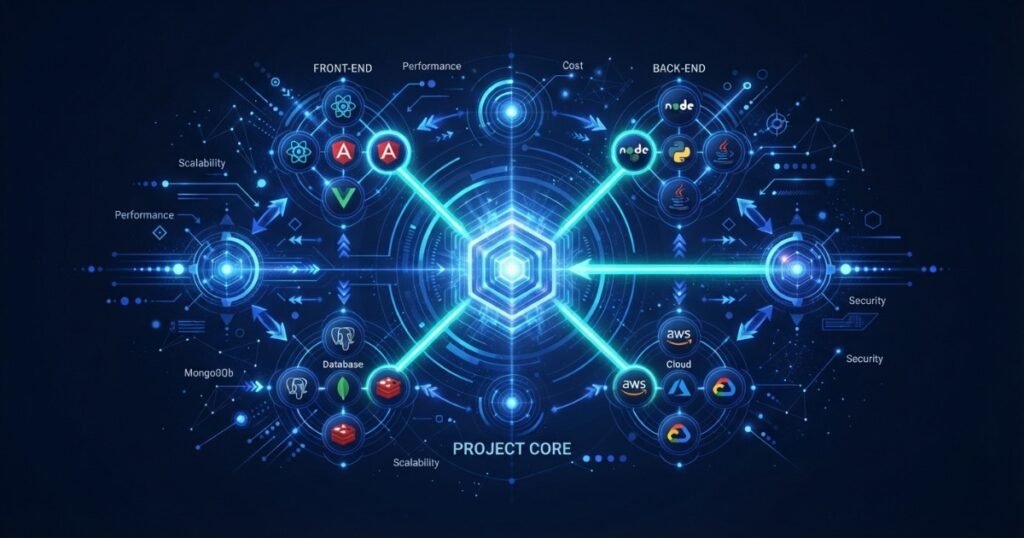
Choosing the Right Tech Stack for Your Software Project
Every software project starts with a foundational, often under-scrutinised decision: which programming languages, frameworks, and databases will actually power it. A tech stack is the complete set of technologies used to build and run a piece of software — frontend framework, backend language, database, and hosting infrastructure — and this decision quietly shapes nearly everything downstream: how fast the team can build, how easy it is to hire, and how gracefully the product scales as it grows. Unlike many technical decisions, a tech stack is genuinely expensive to reverse once real development is underway, which makes getting it right upfront far more valuable than most teams initially appreciate.
At Webtoz, stack decisions are made based on genuine project requirements, an approach closely tied to the framework thinking in React, Vue, and Angular and the broader discipline in full-stack web development.
This guide covers why tech stack decisions outlive the people who make them, the key considerations across frontend, backend, and database choices, how to match a stack to your team and hiring market, scalability and future-proofing, and a practical framework for making this decision well.
📖 In This Guide
- Why Tech Stack Decisions Outlive the People Who Make Them
- Frontend, Backend, and Database Considerations
- Tech Stack Decision Factors
- Matching Stack to Team Skills and Hiring Market
- Scalability and Future-Proofing Considerations
- When to Follow Trends and When to Ignore Them
- Common Mistakes
- How to Choose a Tech Stack
- Final Thoughts: Boring and Proven Beats Exciting and Risky
1. Why Tech Stack Decisions Outlive the People Who Make Them
A tech stack chosen in the first weeks of a project often outlasts the founder who made the decision, the original developers who built the first version, and several rounds of company strategy. Migrating a mature codebase from one stack to another is one of the most expensive undertakings in software engineering, frequently more costly than the original build itself — which means a stack decision made hastily under early-stage pressure can quietly constrain a business for years after nobody remembers exactly why it was chosen.
This longevity is exactly why the decision deserves real deliberation, even when a founder or team is eager to start building immediately. The few extra days spent genuinely evaluating options are trivial compared to the months a poorly matched stack can cost in slowed development, difficult hiring, or an eventual painful migration years down the line.
There’s a useful mental exercise worth running before committing: imagine explaining the stack decision to a new engineering lead joining three years from now, who wasn’t part of the original conversation. If the honest answer to “why this stack” is genuinely a considered set of trade-offs, that’s a good sign. If the honest answer is closer to “it was what the founding developer happened to know,” that’s worth pausing on before locking it in.
2. Frontend, Backend, and Database Considerations
Each layer of the stack carries its own genuinely distinct set of trade-offs. Frontend choice affects development speed and interface flexibility. Backend language choice affects performance characteristics, ecosystem maturity, and how easily the team can find experienced developers. Database choice affects how naturally your actual data model fits — relational databases suit structured, interrelated data, while NoSQL options suit flexible, rapidly evolving data shapes. None of these decisions happen in isolation either — certain frontend and backend combinations have significantly better tooling and community support than others, which is worth weighing alongside each layer’s individual merits.
It’s also worth considering how these layers will need to communicate with each other over the life of the project. A frontend and backend built by teams with genuinely shared conventions and expectations around data formats tend to integrate far more smoothly than two technically excellent but mismatched choices forced together after the fact.
Does the “best” programming language actually matter for most business applications?
For the large majority of business applications, several mature languages could all serve the project perfectly well — the meaningful differences show up in ecosystem maturity, hiring availability, and team familiarity far more than in raw language performance. Debates over which language is technically “best” tend to matter far less in practice than choosing one your team can execute confidently and reliably.
3. Tech Stack Decision Factors
4. Matching Stack to Team Skills and Hiring Market
The most technically elegant stack in the world is a liability if your team can’t build on it efficiently, or if you can’t hire for it when you need to grow. A stack your existing team already knows well lets development start immediately with fewer early mistakes, while a stack with a healthy, active local or remote hiring market means future growth won’t be bottlenecked by an inability to find qualified developers at a reasonable cost. This is exactly why the “best” stack in the abstract isn’t always the right stack for a specific team at a specific moment.
It’s worth extending this thinking beyond the immediate team to the broader talent pool the business will eventually need to draw from as it grows. A stack that’s popular globally but scarce in your specific hiring region, or vice versa, can quietly complicate recruitment in ways that only become apparent once the business is actively trying to hire and struggling to find qualified candidates at a reasonable cost.
5. Scalability and Future-Proofing Considerations
Scalability deserves genuine consideration, but it’s easy to over-index on hypothetical future scale at the expense of actually shipping the product today. A reasonable approach chooses technologies with a clear, well-documented path to scale — even if that path isn’t taken immediately — rather than either ignoring scalability entirely or over-engineering for a scale the product may never actually reach. Most mature, mainstream stacks can comfortably support the traffic and complexity of the vast majority of business applications; scalability concerns tend to matter most for a narrower set of genuinely high-growth or high-traffic products.
It’s worth remembering too that architecture, not just language choice, is usually the bigger lever on genuine scalability — a well-architected application on a “less trendy” stack will typically outperform a poorly architected one built on whatever technology currently has the most hype, regardless of the underlying language’s theoretical performance ceiling.
6. When to Follow Trends and When to Ignore Them
New frameworks and languages appear constantly, each with enthusiastic early adopters claiming it solves problems the previous generation couldn’t. A genuinely new technology is worth adopting when it solves a real, specific problem your current stack demonstrably struggles with — not simply because it’s generating excitement online. Mature, boring, well-documented technologies with large communities and a long track record consistently produce more reliable, lower-risk outcomes for business-critical software than bleeding-edge tools still working out their own rough edges.
There’s a useful distinction between technologies worth watching and technologies worth betting a business on. It’s entirely reasonable to stay informed about emerging tools and even prototype with them on the side — the mistake is committing a business-critical production system to something that hasn’t yet accumulated the community knowledge, tooling maturity, and battle-testing that make troubleshooting straightforward when something inevitably goes wrong.
Is it ever worth adopting a brand-new, unproven technology for a business project?
Occasionally, when it offers a genuine, meaningful advantage for your specific use case that mature alternatives simply can’t match — but this should be a deliberate, informed trade-off, not a default choice. A useful test is asking whether the team would still choose it if all the current hype disappeared tomorrow, leaving only its actual technical merits and documentation quality to evaluate.
7. Common Mistakes
These mistakes recur across projects that later regret their original stack decision.
- Chasing hype over genuine fit: Choosing a technology because it’s trending, not because it solves a real problem.
- Ignoring the local hiring market: Building on a stack that’s genuinely difficult to hire for later.
- Over-engineering for hypothetical scale: Adding complexity for a scale the product may never actually reach.
- Letting one developer’s personal preference decide: A team-wide decision deserving a team-wide evaluation.
- Mixing too many unrelated technologies: Adding operational complexity without a genuine corresponding benefit.
- Never revisiting the decision as the project matures: Staying locked into an early choice long after it stops fitting.
- Copying a much larger company’s stack wholesale: Adopting infrastructure complexity sized for a scale and team you don’t actually have.
How to Choose a Tech Stack
A structured process for making this decision deliberately rather than defaulting to whatever’s currently popular.
1. Define Real Requirements
List actual features and constraints before comparing technologies.
2. Assess Team Expertise
Weigh existing skills against the cost and time of learning something new.
3. Check the Hiring Market
Confirm you can realistically hire for this stack as the team grows.
4. Evaluate Ecosystem Maturity
Favour well-documented, actively maintained technologies with strong communities.
5. Consider Realistic Scale
Plan for genuine projected growth, not an unlikely hypothetical peak.
6. Decide and Commit
Avoid second-guessing the stack mid-project once development is underway.
8. Final Thoughts: Boring and Proven Beats Exciting and Risky
The most successful software projects are rarely built on the most exciting, cutting-edge technology of the moment — they’re built on mature, well-understood tools that let the team focus on solving the actual business problem instead of fighting unfamiliar, unproven infrastructure. Choosing a tech stack based on genuine team fit, hiring realities, and real project requirements, rather than trends, is one of the highest-leverage decisions a project makes in its first few weeks. That decision deserves the extra scrutiny, well before the first line of code gets written.
Starting a new project and want the right stack from the beginning? Explore our custom software development services, review our pricing, or contact us for an honest technical recommendation.
About Webtoz Solutions Team
Webtoz is a full-service web development, software engineering, and technology consultancy, choosing tech stacks based on genuine project fit and real business needs, not trends. Learn more about us, or get in touch to discuss your project.
Ready to Build on the Right Stack?
Let Webtoz help you choose and build on a tech stack that genuinely fits your team, budget, hiring plans, and long-term growth trajectory.
Get in Touch →