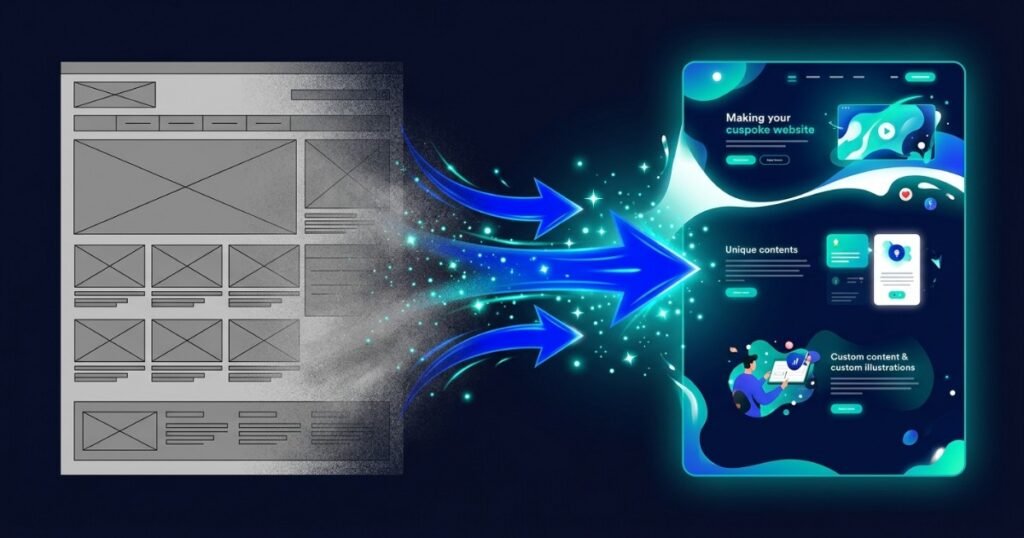
Custom vs Template Websites: Why Businesses Are Moving Away from Themes
A few years ago, buying a $60 theme and installing a dozen plugins was a perfectly sensible way to get a business online fast and cheap. That calculation has changed. As themes have grown more generic and plugin-dependent to stay “flexible” for every possible use case, they’ve also grown heavier, slower, and harder to secure — while custom development has become more accessible and cost-effective than it used to be. The result is a steady migration: businesses that started on a template are increasingly moving to custom-built sites once they hit the ceiling of what a theme can reasonably do — usually right around the moment their website stops being a side project and starts being a genuine growth engine for the business.
At Webtoz, a large share of our work is exactly this transition — taking a business off a bloated, plugin-heavy theme and rebuilding on a lean, purpose-built foundation. It’s a pattern that shows up throughout the conversion issues we cover in 10 web design mistakes killing conversions — many of them trace directly back to template limitations.
In this guide, we’ll break down exactly what separates a template-based website from a custom-built one, where themes genuinely still make sense, the hidden long-term costs of staying on a theme past a certain point, and a framework for deciding which path is right for your business today.
📖 In This Guide
- What Is a Template-Based Website, Really?
- What Is a Custom-Built Website?
- Custom vs Template: A Side-by-Side Comparison
- Why Businesses Are Moving Away from Themes
- When a Template Still Makes Sense
- The Hidden Long-Term Cost of Staying on a Theme
- How to Decide Which Path Is Right for You
- Final Thoughts: Build for Where You’re Going, Not Just Where You Are
1. What Is a Template-Based Website, Really?
A template — often called a theme — is pre-built code sold to thousands of different businesses, designed to be generic enough that a bakery, a law firm, and a software company could all technically use it. To adapt that generic foundation to your specific needs, you typically stack plugins on top of it: one for forms, one for SEO, one for page building, one for speed, one for security — each adding its own code, its own update cycle, and its own potential point of failure. The site you end up with is really a patchwork of other people’s software, loosely held together, rather than something engineered specifically for your business.
2. What Is a Custom-Built Website?
A custom website is built from the ground up around your specific business, your specific users, and your specific goals — not retrofitted from a generic starting point. Every line of code exists because it serves a purpose on your site; there’s no dead weight from features you’ll never use, and no compromises made to keep the codebase flexible enough for ten thousand other unrelated businesses. This doesn’t mean building everything from scratch with zero tooling — it means the architecture, design system, and functionality are deliberately chosen and assembled specifically for you.
This distinction matters most in the details a visitor never consciously notices but subconsciously feels: page transitions that match your brand’s pace, a checkout flow shaped around how your specific customers actually shop, or an admin dashboard your team can actually use without fighting a generic interface built for ten thousand other kinds of businesses. None of that is impossible on a theme — it’s just disproportionately expensive and fragile to force onto a foundation that was never designed for it.
Are custom websites always more expensive than themes?
The upfront cost is usually higher, but the total cost of ownership often isn’t. A theme-based site racks up ongoing costs in plugin licences, security patching, performance fixes, and eventually a full rebuild once the theme is abandoned by its developer. A custom site avoids most of that recurring overhead. Our services and pricing page breaks down what a custom build typically involves.
Can I start on a template and migrate to custom later without losing everything?
Yes, and it’s a completely normal path — content, branding, and SEO history can all carry over to a custom rebuild with proper planning. The main things worth doing carefully are exporting your content in a structured format and mapping your existing URLs so nothing breaks along the way, which is exactly the process we cover in how to move your website without losing SEO rankings.
3. Custom vs Template: A Side-by-Side Comparison
4. Why Businesses Are Moving Away from Themes
The shift away from templates is being driven by real, felt pain points rather than trends. Businesses discover their site looks like every competitor using the same popular theme, that page-builder-generated code is bloated and hard to make fast, that a plugin update breaks the layout with no warning, or that their developer can’t add a genuinely custom feature without fighting the theme’s own architecture at every step. Each of these frustrations, individually, might be tolerable. Together, they add up to a website that’s actively working against the business rather than for it.
There’s usually a specific triggering moment too — a competitor launches a noticeably sharper site, a customer mentions the checkout felt clunky, or a developer quotes an uncomfortable number of hours just to move a button because of how the theme’s builder locks down layout control. It’s rarely one dramatic failure; it’s an accumulation of small frictions that eventually cross a threshold.
Plugin Conflicts
Updates that quietly break other plugins or the theme itself.
Bloated Load Times
Unused features shipping code your visitors never asked for.
Generic Appearance
Looking indistinguishable from thousands of other sites using the same theme.
Feature Ceilings
Hitting a wall the moment a genuinely custom feature is required.
5. When a Template Still Makes Sense
Custom isn’t the right answer for every situation, and it’s worth being honest about that. A very early-stage business validating a new idea, a short-lived campaign microsite, or a hobby project with no real growth ambitions can reasonably start on a template — speed and low cost genuinely matter more than architecture at that stage. The distinction is that a template should be treated as a starting point to outgrow, not a permanent foundation for a business that intends to scale. Even in these cases, it’s worth choosing a well-supported, actively maintained theme rather than the cheapest option available, since a poorly maintained template can create security and performance problems even for a short-lived project.
A useful gut check is asking whether the website itself is the product, or just a placeholder while the actual business idea gets tested. If it’s the latter, a theme is a perfectly reasonable choice — the mistake only happens when that “temporary” placeholder is still running the business, unchanged, three years and considerable revenue later.
6. The Hidden Long-Term Cost of Staying on a Theme
- Recurring plugin licence fees that add up to more than a custom build over a few years.
- Developer hours spent fighting the theme instead of building the feature you actually need.
- Performance losses that cost conversions every single day the site stays slow.
- Security patching across a dozen plugins instead of one lean, controlled codebase.
- An eventual forced rebuild when the theme is abandoned or becomes incompatible with a platform update.
- Slower time-to-market on new features as every request gets filtered through what the theme’s builder technically allows.
- Brand dilution from a design that visitors may have already seen on a competitor’s site running the same theme.
How to Decide Which Path Is Right for You
Use this sequence to make an informed, honest decision rather than a default one.
1. Assess Your Growth Trajectory
Are you validating an idea, or scaling an established business?
2. List Non-Negotiable Features
Identify anything a standard theme genuinely can’t do well.
3. Calculate True Cost of Ownership
Compare plugin fees and maintenance over 3 years, not just upfront price.
4. Audit Performance Requirements
Decide how much speed and Core Web Vitals performance matters to your goals.
5. Choose the Right Partner
Work with a team that can execute either path well, rather than one that only knows themes.
7. Final Thoughts: Build for Where You’re Going, Not Just Where You Are
A template can absolutely get a business online. The question worth asking isn’t whether a theme can work today — it’s whether it will still be working, without friction, in two years, when your business looks nothing like it does now. Businesses moving away from themes aren’t chasing a trend; they’re recognising that the flexibility a generic template once offered has quietly become the thing holding them back. The earlier that recognition happens, the less expensive and disruptive the eventual transition tends to be.
Ready to see what a custom-built website could do for your business? Explore our custom web development services, check our pricing, or contact us for a candid assessment of your current site.
About Webtoz Solutions Team
Webtoz is a full-service web development, software engineering, and technology consultancy. We help businesses transition from bloated themes to lean, custom-built websites engineered to scale. Learn more about us, or get in touch to discuss your project.
Ready for a Website Built Specifically for Your Business?
Let Webtoz design and build a custom website engineered around your goals — not a template’s limitations.
Get in Touch →