Headless Commerce Explained: Is It Right for Your Online Store?
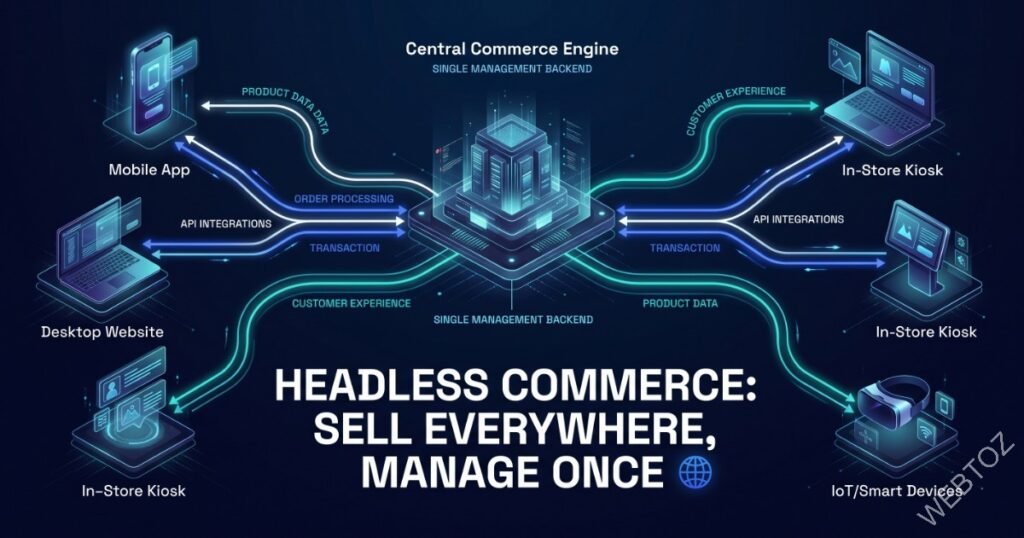
Traditional e-commerce platforms bundle the storefront design and the commerce engine — inventory, cart, checkout — into one system. Headless commerce separates them: the commerce engine handles transactions and inventory through an API, while the storefront is built completely independently, using whatever technology delivers the best customer experience.
This guide explains headless commerce in plain terms and helps you decide whether it is worth the added complexity for your store. It builds on our broader guide to e-commerce website development features and the concepts covered in headless CMS explained.
You will learn how headless commerce works, why growing retailers adopt it, and the honest trade-offs involved before you commit.
📖 In This Guide
1. What Headless Commerce Actually Means
In a headless commerce setup, the backend commerce engine — product data, inventory, cart, checkout, payments — is accessed entirely through an API, and the front end is a separately built application with full design freedom. The same commerce backend can power a website, a mobile app, and even in-store kiosks simultaneously.
Commerce Engine
Handles inventory, cart, and checkout logic through an API layer.
Custom Storefront
Fully designed and engineered independently, without template constraints.
Multi-Channel Ready
One commerce backend can serve web, app, and in-store channels at once.
2. Why Growing Retailers Adopt It
The primary driver is almost always speed and customer experience at scale. A custom-built storefront can be optimised aggressively for conversion and Core Web Vitals in ways that template-bound platforms cannot match once traffic and catalogue size grow significantly.
3. The Honest Trade-offs
4. Signs You Might Need It
- Your catalogue is large and complex: Standard platform templates struggle with your product data.
- You sell across multiple channels: Web, app, and marketplace all need the same live inventory.
- Conversion optimisation is a competitive priority: You need full control over every element of the shopping experience.
5. Common Questions
5. Common Questions
Is headless commerce only for large enterprises?
Historically yes, but the barrier to entry has dropped significantly. Modern commerce APIs make it accessible to well-funded mid-market retailers too, not just large enterprises with dedicated engineering teams.
Can we migrate to headless commerce gradually?
Yes, a phased migration is common and lower risk. Many retailers rebuild high-traffic pages first — such as the homepage or top category pages — before migrating the entire storefront.
How to Evaluate Headless Commerce for Your Store
1. Assess Current Platform Limits
Identify what your current platform genuinely cannot do.
2. Map Your Channels
List every place your products need to appear.
3. Estimate Engineering Capacity
Confirm you have or can access the team needed to maintain a custom storefront.
4. Choose a Commerce Backend
Select an API-first commerce platform suited to your catalogue.
5. Build a Phased Migration Plan
Prioritise high-traffic pages first to reduce risk.
6. Measure Against Your Old Platform
Track conversion and speed metrics side by side during rollout.
6. Final Thoughts: Powerful, Not Universal
Headless commerce is a genuine competitive advantage for the retailers who need it — but it is an investment in engineering capability, not just a technology choice, and should be evaluated with that in mind.
Considering headless commerce for your store? Contact us for an honest assessment, or explore our custom software development services.
About Webtoz Solutions Team
Webtoz is a full-service web development, software development, and technology consultancy. Learn more about our team, explore our services, or get in touch.
Ready to See If Headless Commerce Fits Your Store?
Let us assess your catalogue, channels, and team capacity honestly.
Get in Touch →