How Much Does Custom Web Development Cost in 2026? Full Pricing Breakdown
Asking “how much does a website cost?” is a bit like asking “how much does a building cost?” — the honest answer is it depends entirely on what you’re building, and pretending otherwise just leads to disappointing quotes or disappointing websites. Still, business owners deserve real numbers to plan around, not vague “contact us for pricing” deflection.
At Webtoz, we believe in transparent, scope-based pricing rather than one-size-fits-all packages. This guide breaks down the real cost drivers behind custom web development, with realistic price ranges by project type, so you can budget with confidence before your first conversation with a development partner.
You’ll learn what actually drives the price of a custom website up or down, typical cost ranges across project types, and the hidden costs many businesses forget to budget for. If you’re still deciding between a CMS and a fully custom build, our companion guide on WordPress vs. custom web development is a useful starting point.
📖 In This Guide
- What Actually Drives Custom Web Development Cost
- Pricing Ranges by Project Type
- Fixed Price vs. Time & Materials vs. Retainer
- Hidden Costs Businesses Often Forget to Budget For
- How to Get an Accurate Quote
- Common Pricing Questions
- How to Budget for Your Project, Step by Step
- Final Thoughts: Price Follows Scope
1. What Actually Drives Custom Web Development Cost
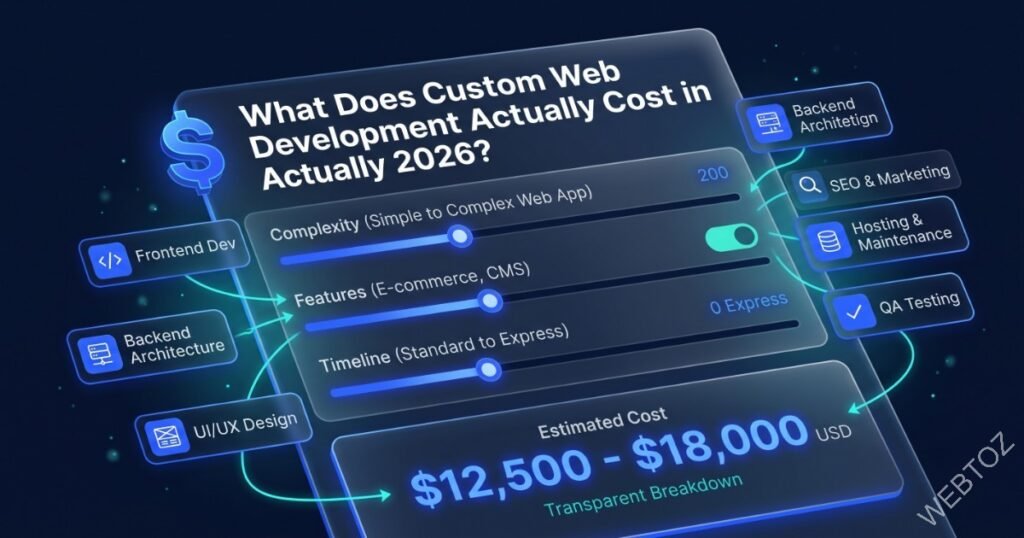
Five factors explain almost all of the variance in custom web development pricing: the number and complexity of unique page templates, the depth of third‑party integrations, whether the site needs custom back‑end logic, the level of design customisation, and ongoing content or e‑commerce management needs. A marketing site with five page types costs a fraction of a platform with user accounts, payments, and a custom admin dashboard.
Page Complexity
Unique templates and interactive components cost more than repeated content layouts.
Integrations
Every payment gateway, CRM, or internal API adds engineering and testing time.
Back‑End Logic
User accounts, custom dashboards, and business rules require real software engineering, not just page design.
2. Pricing Ranges by Project Type
Ranges vary by region and team, but the table below reflects the general shape of custom web development pricing based on project category, aligned with our own service tiers.
3. Fixed Price vs. Time & Materials vs. Retainer
Beyond project scope, the pricing model itself changes how cost and risk are shared between you and your development partner. A fixed-price model suits well-defined scopes; time and materials suits evolving requirements; a retainer suits ongoing product development. Learn more about how these map to real engagements in our guide on Webtoz digital creation services.
Fixed Price
Best when scope is well‑defined upfront; predictable cost, less flexibility mid‑project.
Time & Materials
Best when requirements will evolve; pay for actual work done, with full flexibility.
Retainer
Best for ongoing development and support once the initial build is live.
4. Hidden Costs Businesses Often Forget to Budget For
- Hosting and infrastructure: Especially for dynamic sites and web applications with backend services.
- Third‑party licensing: Payment processors, mapping APIs, or analytics tools often have their own fees.
- Content creation: Copywriting, photography, and video are frequently scoped separately from development.
- Post‑launch support: Bug fixes, security patches, and small iterative improvements after go‑live.
- Future scalability work: Features you didn’t need at launch but will need as you grow.
5. How to Get an Accurate Quote
The single best way to get a reliable quote is to walk into the conversation with clarity on your business goals, even if you don’t yet know the technical details. A good development partner will translate your business requirements into a scoped estimate — you shouldn’t need to speak “developer” to get an honest number.
6. Common Pricing Questions
Why do custom web development quotes vary so much between agencies?
Because scope assumptions differ, even for the same brief. One agency might assume a basic CMS integration while another scopes a fully custom admin panel. Always compare quotes against a shared, written scope document, not just a final number.
Is the cheapest quote ever the right choice?
Rarely, once you factor in total cost of ownership. Underpriced projects often cut corners on architecture, testing, or documentation — costs that resurface later as rework, security issues, or a site that can’t scale.
How to Budget for Your Project, Step by Step
Use this process to walk into your first quote conversation prepared and confident.
1. List Your Must‑Have Features
Separate must‑haves from nice‑to‑haves before requesting quotes.
2. Identify Required Integrations
List every existing system the new site needs to connect to.
3. Set a Realistic Timeline
Understand that compressed timelines usually increase cost.
4. Request Scoped Quotes
Ask for a written scope alongside every quote so comparisons are apples-to-apples.
5. Budget for Post‑Launch Support
Reserve a portion of budget for the first few months after go‑live.
6. Choose a Pricing Model That Fits
Match fixed price, time & materials, or retainer to how well-defined your scope really is.
7. Final Thoughts: Price Follows Scope
There’s no universal number for what a custom website costs, because there’s no universal website. The businesses that budget most successfully are the ones that define their outcomes clearly first, then let scope — not a headline number — drive the conversation.
Ready for a transparent, scope-based quote? Explore our services and pricing page or contact us for a free scoping conversation.
About Webtoz Solutions Team
Webtoz is a full‑service web development, software development, and technology consultancy. Learn more about our team, explore our services, or get in touch.
Ready to See What Your Project Would Actually Cost?
Share your requirements and get a scoped, honest estimate — no inflated packages, no vague numbers.
Get in Touch →