Native vs Cross-Platform App Development: Pros, Cons, and Costs
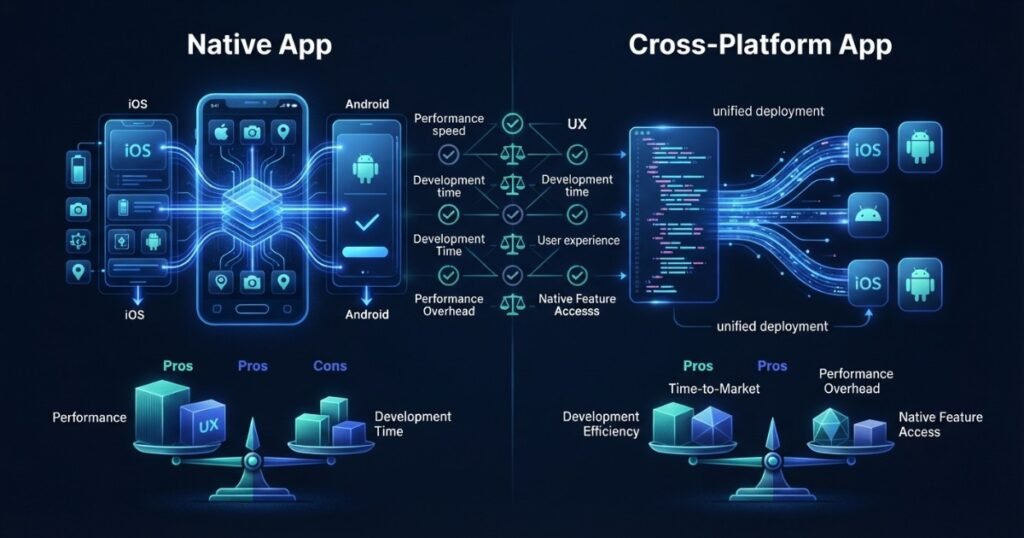
Before a single screen gets designed or a line of code gets written, every mobile app project faces a foundational decision that shapes everything downstream: build separately for iOS and Android using each platform’s own native tools, or build once using a cross-platform framework that runs on both. Native development means writing platform-specific code for iOS and Android independently, giving maximum access to each platform’s capabilities and the smoothest possible performance. Cross-platform development means writing one shared codebase that compiles to run on both platforms, trading some platform-specific flexibility for significantly faster development and lower cost. Neither is a universally correct choice — the right answer depends on what your specific app actually needs to do and who’s using it.
At Webtoz, we build both native and cross-platform applications depending on genuine project requirements, a decision closely tied to the budgeting conversation in mobile app development cost in 2026 and the framework thinking in React, Vue, and Angular for the web.
This guide covers what native and cross-platform development actually involve, a direct comparison across cost, performance, and timeline, the real user experience differences, and a practical framework for choosing the right approach for your specific app.
📖 In This Guide
- What Native Development Actually Means
- What Cross-Platform Development Actually Means
- Comparison Table
- Performance and User Experience Differences
- When Native Is the Right Choice
- When Cross-Platform Is the Right Choice
- Common Mistakes
- How to Choose Between Native and Cross-Platform
- Final Thoughts: Match the Approach to the Product
1. What Native Development Actually Means
Native development means writing an app using each platform’s own official language and tools — Swift for iOS, Kotlin for Android — with direct, unfiltered access to every capability the operating system offers. This gives native apps the smoothest possible performance, the most immediate access to new OS features when they’re released, and an interface that feels perfectly native to each platform’s own design conventions, since it’s built using the platform’s own official design system rather than an approximation of it. The trade-off is that you’re essentially building and maintaining two separate applications, with two separate codebases, two sets of platform-specific expertise required, and two testing cycles.
This duplication compounds over the life of the app, not just at initial build. Every new feature needs to be built twice, every bug needs to be diagnosed and fixed independently on each platform, and keeping feature parity between the iOS and Android versions requires deliberate, ongoing coordination that a single shared codebase simply doesn’t need.
2. What Cross-Platform Development Actually Means
Cross-platform frameworks let developers write one shared codebase that compiles down to genuinely native apps on both iOS and Android, rather than a compromise web-based wrapper pretending to be a native app. Modern cross-platform frameworks have closed much of the performance and feel gap that used to make cross-platform apps feel noticeably second-rate — for the large majority of business applications, users genuinely can’t tell the difference, and development happens significantly faster with one team working on one codebase instead of two. The trade-off shows up mainly in edge cases: apps that need to push the absolute limits of device hardware, or apps that need day-one access to a brand-new platform-specific feature the moment it’s released.
The maturity of cross-platform tooling has genuinely changed the calculus over the past several years. What used to be a clear trade-off between speed and quality has narrowed considerably, to the point that the decision now depends much more on your specific app’s requirements than on any blanket assumption about cross-platform being an inherent compromise.
Can users actually tell the difference between a native app and a well-built cross-platform app?
For the vast majority of typical business apps, no — modern cross-platform frameworks render genuinely native UI components, not a web view pretending to be native, so the day-to-day experience feels indistinguishable to most users. The difference becomes noticeable mainly in apps pushing graphics-intensive performance, like high-end games, or apps depending on very recent, platform-specific hardware features that cross-platform tooling hasn’t fully caught up to yet.
3. Comparison Table
4. Performance and User Experience Differences
In genuinely graphics-intensive scenarios — high-end gaming, complex animations, or augmented reality — native development still holds a measurable performance edge, since it’s working directly with each platform’s hardware without any abstraction layer in between. For the large majority of business apps — content browsing, forms, e-commerce, booking, messaging — modern cross-platform frameworks perform smoothly enough that the difference is imperceptible to real users going about their normal usage. The performance conversation matters most when it’s specifically relevant to your app’s core function, not as a blanket concern applied to every project regardless of what it actually does.
It’s worth testing this assumption directly rather than taking it on faith either way. Building a small prototype of the app’s most demanding interaction — a complex animation, a data-heavy screen, a camera-based feature — in a cross-platform framework gives a concrete answer to whether performance is genuinely a concern for your specific product, rather than relying on generic advice that may not apply to your particular use case.
5. When Native Is the Right Choice
Native development earns its higher cost and longer timeline when an app’s core value proposition genuinely depends on platform-specific performance or capabilities. Graphics-intensive games, apps making heavy use of augmented reality or complex camera processing, and apps that need immediate access to brand-new platform features the moment they launch are all strong candidates for native development, where the performance and capability advantages directly translate into a better core product experience.
Enterprise apps with strict security requirements that depend on the deepest possible integration with a device’s underlying security features also frequently lean toward native, since that level of platform-specific control is harder to achieve consistently through a cross-platform abstraction layer.
6. When Cross-Platform Is the Right Choice
Cross-platform is the right default for the majority of business applications, particularly for startups and businesses that need to reach both iOS and Android users without doubling their development budget and timeline. Content-driven apps, e-commerce and booking apps, internal business tools, and MVPs looking to validate an idea before committing to a larger investment all benefit enormously from cross-platform’s speed and cost efficiency, without meaningfully compromising the actual user experience for the vast majority of real users.
Reaching both platforms simultaneously also matters strategically for many early-stage products. Launching on only one platform to save cost often means missing a meaningful share of the potential market from day one, whereas cross-platform lets a smaller team reach the whole addressable audience without that trade-off.
Can a cross-platform app be converted to native later if it succeeds?
Technically yes, though it’s genuinely a rebuild rather than a simple migration, since the underlying codebases work in fundamentally different ways. In practice, most successful apps that started cross-platform never actually need to make that switch — once performance is genuinely good enough for the vast majority of users, the business case for a costly native rebuild rarely materialises unless the product’s core function specifically changes to demand it.
7. Common Mistakes
These mistakes come up repeatedly when businesses make this decision without fully understanding what each path actually involves.
- Choosing native out of unnecessary caution: Paying a significant premium for performance benefits the app will never actually need.
- Choosing cross-platform for a performance-critical app: Compromising the app’s core value proposition to save on development cost.
- Underestimating the ongoing cost of two native codebases: Every future feature effectively gets built twice, indefinitely.
- Assuming all cross-platform frameworks are equivalent: Different frameworks have genuinely different maturity and performance characteristics.
- Deciding based on developer preference alone: Letting an existing team’s comfort override what the product genuinely needs.
- Not planning for feature parity between platforms: Letting the iOS and Android versions of a native app drift apart over time.
- Launching on one platform only to save money: Missing a meaningful share of the addressable market from day one.
- Ignoring the hiring market for the chosen approach: Some native and cross-platform skill sets are considerably harder to hire for in certain regions.
How to Choose Between Native and Cross-Platform
A practical framework for making this decision based on your specific app, not general advice.
1. Define Core Performance Needs
Determine if the app’s core value genuinely depends on maximum performance.
2. Assess Budget and Timeline
Weigh what native’s higher cost and timeline would mean for your launch plan.
3. Consider Long-Term Maintenance
Factor in the ongoing cost of maintaining one codebase versus two.
4. Prototype Key Interactions
Test critical, performance-sensitive interactions before committing fully.
5. Match to Team Expertise
Weigh existing skills against the cost of retraining or hiring differently.
6. Decide and Commit
Avoid second-guessing the choice mid-project once development is underway.
8. Final Thoughts: Match the Approach to the Product
Neither native nor cross-platform is the objectively correct default — each is the right tool for a specific set of circumstances, and the businesses that choose well are the ones honest with themselves about what their app genuinely needs versus what would simply be nice to have. For most business applications, cross-platform delivers the vast majority of the user experience at a fraction of the cost and timeline; for apps where performance is the core product, native remains the right investment. The decision is rarely permanent either — plenty of successful products have started cross-platform and only reconsidered native much later, once real usage data justified the investment. Make the decision based on your product’s actual requirements, not a general reputation either approach happens to carry, and don’t be afraid to prototype the riskiest interaction before committing fully to one path over the other.
Not sure which approach fits your app idea? Explore our custom software development services, review our pricing, or contact us for an honest recommendation.
About Webtoz Solutions Team
Webtoz is a full-service web development, software engineering, and technology consultancy, building both native and cross-platform apps matched to genuine project needs and real budgets. Learn more about us, or get in touch to discuss your app idea.
Ready to Build the Right Way From the Start?
Let Webtoz help you choose and build the approach that genuinely fits your app’s needs, timeline, and budget.
Get in Touch →