Software Development Life Cycle (SDLC): A Practical Guide for Founders
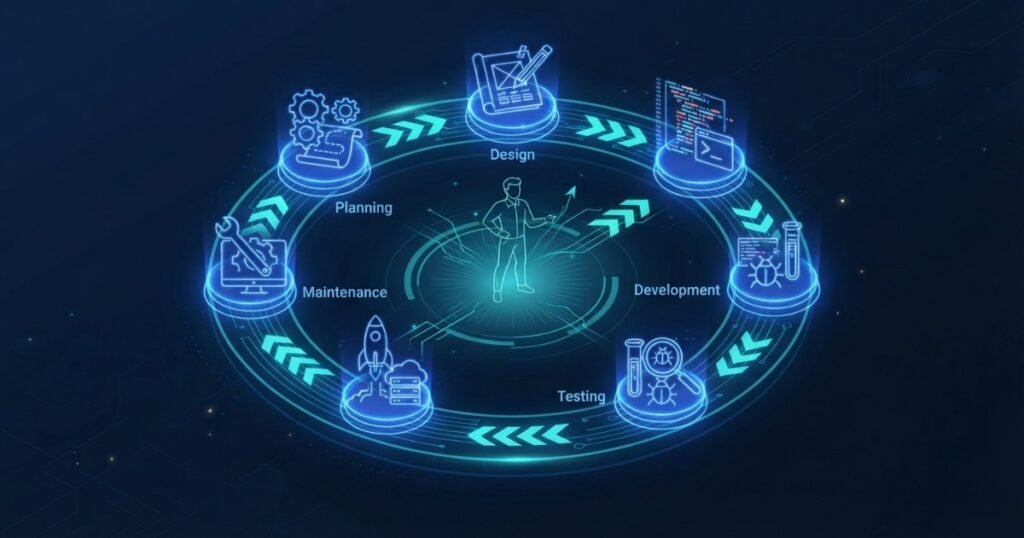
Every piece of software that’s ever shipped moved through some version of the same underlying sequence, whether the team building it called it by name or not. The Software Development Life Cycle, or SDLC, is the structured process software moves through from initial idea to a working, maintained product — planning, design, development, testing, deployment, and ongoing maintenance — and understanding it gives a non-technical founder a genuine framework for evaluating progress, spotting risk early, and asking better questions of the team building their product. You don’t need to become a developer to benefit from this framework; you just need enough literacy to recognise which phase a project is actually in, and what “done” genuinely means at each stage.
At Webtoz, every project follows a disciplined SDLC, adapted in intensity to fit the project’s scale — the same discipline underlying our approach to MVP development and the broader guidance in custom web application timelines and costs.
This guide covers what SDLC actually is and why it matters to founders specifically, the core phases every project moves through, the most common methodologies used to organise them, where founders most often get this wrong, and how SDLC connects directly to building a strong MVP.
📖 In This Guide
- What SDLC Actually Is and Why Founders Should Care
- The Core Phases of SDLC
- SDLC Phases and What Happens in Each
- Popular SDLC Methodologies
- Where Founders Most Often Get SDLC Wrong
- How SDLC Connects to MVP Development
- Common Mistakes
- How to Apply SDLC to Your Project
- Final Thoughts: Process Protects the Product
1. What SDLC Actually Is and Why Founders Should Care
SDLC sounds like a term meant only for engineers, but it’s genuinely useful for anyone responsible for a software project’s outcome, budget, or timeline. It’s the structured sequence software moves through, from an idea in someone’s head to a working product real users depend on — and every skipped or rushed phase in that sequence tends to resurface later as a bug, a missed requirement, or a feature that doesn’t actually match what the business needed. A founder who understands this sequence can spot a project quietly skipping a crucial phase long before that gap becomes an expensive, visible problem.
Think of SDLC less as a rigid corporate process and more as a checklist of questions any well-run project needs to genuinely answer at some point: what problem are we solving, how will it work, does it actually work as built, and how will it keep working once real people depend on it. Different teams answer these questions with different levels of formality, but skipping the questions entirely is where projects go wrong.
There’s also a genuine financial argument for founders to care about this. Every hour spent fixing a problem that could have been caught earlier in the cycle is an hour not spent building new value — and industry experience consistently shows that the cost of fixing a defect grows the later it’s discovered, making early, disciplined phases a direct form of cost control, not just process for its own sake.
2. The Core Phases of SDLC
While different methodologies organise these phases differently, nearly every software project moves through the same underlying stages in some form. Planning clarifies what’s being built and why. Design translates that plan into a concrete technical and visual blueprint. Development is where the actual building happens. Testing verifies the result works as intended before real users ever see it. Deployment releases it into the real world. Maintenance keeps it running, secure, and evolving afterward. Skipping or rushing any one of these phases doesn’t make the underlying work disappear — it just delays it, usually to a more expensive and stressful moment later in the project.
Which SDLC phase do founders most often try to skip?
Planning and testing are the two most commonly compressed or skipped phases, usually under time or budget pressure. Skipping planning means building against assumptions that turn out wrong once real requirements surface. Skipping testing means those same problems get discovered by real users instead of caught before launch — a far more expensive and reputationally damaging way to find them.
3. SDLC Phases and What Happens in Each
4. Popular SDLC Methodologies
Methodologies are simply different ways of organising the same underlying phases, each with different assumptions about how much certainty exists upfront. Waterfall completes each phase fully before moving to the next, working best when requirements are genuinely well understood in advance. Agile and Scrum break work into short, iterative cycles with regular check-ins and the flexibility to adjust direction as real feedback comes in, working best when requirements are likely to evolve as the product takes shape. Most modern software projects, especially early-stage startup products, lean toward Agile precisely because certainty is rare that early in a product’s life.
It’s worth understanding that these methodologies aren’t mutually exclusive religions — many successful teams blend elements of both, using more upfront planning for well-understood, stable parts of a system while staying genuinely iterative on the parts still being actively discovered through user feedback.
Scrum specifically organises Agile work into fixed time periods called sprints, typically one to two weeks, each ending with a working, demonstrable increment of the product. This rhythm gives founders a natural, predictable cadence for reviewing progress and providing feedback, rather than waiting months for a single, large reveal that may or may not match what was actually needed.
5. Where Founders Most Often Get SDLC Wrong
First-time founders working with a development team for the first time tend to make a specific set of predictable mistakes around process. They underestimate how much planning genuinely matters, treating it as a delay rather than the foundation that determines whether everything built afterward actually solves the right problem. They also frequently push to skip testing under deadline pressure, not realising that bugs found by real users cost far more — in reputation and lost trust — than bugs caught before launch.
How much should a non-technical founder actually get involved in each SDLC phase?
Involvement should be heaviest during planning, where business context and priorities genuinely need a founder’s input, and lightest during the technical details of development, where the team’s expertise should generally lead. A founder who tries to micromanage technical implementation decisions often slows the project down without adding real value, while a founder who’s absent during planning risks the team building the wrong thing efficiently.
6. How SDLC Connects to MVP Development
An MVP isn’t an exception to SDLC — it’s simply SDLC applied to a smaller, more focused scope, moving through the same phases faster and with a specific hypothesis in mind rather than a fully mature product vision. Skipping planning or testing on an MVP is just as damaging as skipping it on a larger product, since the whole point of an MVP is generating trustworthy evidence — and evidence gathered from a poorly planned, poorly tested product isn’t trustworthy at all. The discipline stays the same; only the scope shrinks.
This connection matters especially for founders in a hurry to validate an idea. The temptation to skip SDLC discipline is strongest precisely when speed feels most urgent — but a rushed MVP that breaks in front of the first real user, or produces misleading data because of a bug rather than genuine user behaviour, wastes far more time correcting course than the discipline would have cost upfront.
7. Common Mistakes
These mistakes show up repeatedly across founder-led software projects, especially first-time ones.
- Treating planning as a delay: Rushing into development before requirements are genuinely clear.
- Pressuring the team to skip testing: Trading a short-term deadline win for a longer-term reputation cost.
- No clear definition of “done” per phase: Ambiguity that leads to mismatched expectations later.
- Micromanaging technical decisions: Slowing the team down without genuinely improving the outcome.
- No plan for the maintenance phase: Assuming the project ends at launch rather than continuing indefinitely.
- Choosing Waterfall for a genuinely uncertain product: Locking in a rigid plan before requirements have actually stabilised.
- No shared definition of quality: The team and the founder silently working from different standards of what “good enough” means.
How to Apply SDLC to Your Project
A practical sequence for founders working with a development team for the first time.
1. Invest Real Time in Planning
Give the team genuine business context before design and development begin.
2. Choose an Appropriate Methodology
Match Waterfall or Agile to how certain your requirements genuinely are.
3. Attend Regular Checkpoints
Stay involved without micromanaging technical implementation details.
4. Insist on Genuine Testing
Don’t let deadline pressure compress or skip the testing phase.
5. Plan Deployment Carefully
Treat launch as a controlled event, not an afterthought.
6. Budget for Maintenance
Treat the SDLC as continuous, not finished the moment the product ships.
8. Final Thoughts: Process Protects the Product
SDLC can feel like unnecessary process overhead to a founder eager to ship fast, but it’s really the opposite — a disciplined process is what protects speed over the life of a project, by catching problems while they’re still cheap to fix rather than after they’ve become expensive, visible failures. Understanding the phases well enough to ask the right questions at the right moments is one of the most valuable, low-cost skills a founder can bring to any software project, technical background or not. That skill pays dividends on every project that follows, not just the first one.
Starting a new software project and want a disciplined process behind it? Explore our custom software development services, review our pricing, or contact us to discuss your project.
About Webtoz Solutions Team
Webtoz is a full-service web development, software engineering, and technology consultancy, running every project through a disciplined SDLC adapted to its actual scale. Learn more about us, or get in touch to discuss your project.
Ready to Build With a Disciplined Process?
Let Webtoz guide your project through a genuine, well-run SDLC — from planning through to long-term maintenance.
Get in Touch →