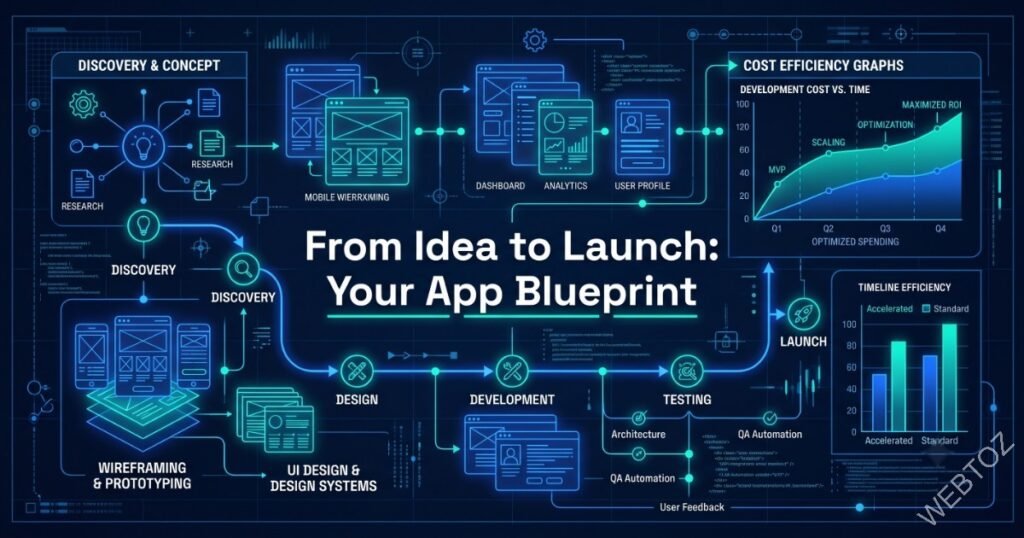
Custom Web Application Development: Process, Timeline & Cost Explained
A web application — a customer portal, an internal dashboard, a booking system with real logic behind it — is a different kind of project than a marketing website. The pages matter less than the logic: how data flows, how users authenticate, how state persists, and how the system behaves under real usage. That difference shapes the entire process, timeline, and cost structure.
This guide breaks down what a custom web application development project actually looks like from first conversation to launch, with realistic timelines for common project sizes. For a broader look at custom development generally, see our complete guide to custom web development services.
You will learn the distinct phases of a web application build, realistic timelines by project size, and the cost factors specific to application logic rather than page design.
📖 In This Guide
- What Makes a Web Application Different from a Website
- The Five Phases of Web Application Development
- Realistic Timelines by Project Size
- What Drives Cost in an Application Build
- Common Causes of Timeline Delays
- Common Questions
- How to Plan Your Application Project
- Final Thoughts: Logic First, Timeline Second
1. What Makes a Web Application Different from a Website
A marketing website mostly presents content. A web application manages state — user accounts, permissions, records that change over time, and business rules that govern what users can and cannot do. That distinction is why application projects require a different discovery process, a different testing approach, and typically a longer timeline than a comparable-looking website.
Authentication & Roles
Different user types with different permissions and views.
Persistent Data
Records that are created, updated, and queried over time.
Business Logic
Rules, calculations, and workflows unique to how your business runs.
2. The Five Phases of Web Application Development
Discovery & Data Modeling
Mapping every user role, data entity, and business rule before design begins.
UX Design & Prototyping
Wireframing key flows for each user role before visual design.
Engineering in Sprints
Building core logic first, then layering features iteratively.
QA & Edge Case Testing
Testing permission boundaries and unusual data states, not just the happy path.
3. Realistic Timelines by Project Size
4. What Drives Cost in an Application Build
Unlike a marketing site, application cost is driven far more by the number of distinct user roles, the complexity of business rules, and the depth of integrations than by visual design. For a general pricing overview, see our guide on custom web development pricing.
5. Common Causes of Timeline Delays
- Undefined business rules: Discovering edge cases mid-build instead of during discovery.
- Scope creep: New features added without adjusting timeline or budget.
- Slow stakeholder feedback: Delayed reviews stall sprint cycles.
- Third-party integration issues: External APIs with incomplete documentation or rate limits.
6. Common Questions
Should we launch an MVP first or build the full application?
For most businesses, an MVP first is the lower-risk path. It validates core assumptions with real users before investing in every feature, and the architecture can be designed from the start to support later expansion.
Who owns the code once the application is built?
You should, so always confirm code ownership in your contract before starting. A reputable development partner hands over full source code and documentation upon final payment.
How to Plan Your Application Project
Follow these steps to reduce risk and keep your timeline realistic.
1. Map Every User Role
List who will use the system and what each role can and cannot do.
2. Define Core Business Rules
Write down the logic that governs your process, even in plain language.
3. Prioritize an MVP Scope
Identify the smallest version that delivers real value.
4. Choose an Engagement Model
Fixed price for defined scope, or time and materials for evolving requirements.
5. Review Progress Every Sprint
Stay engaged with regular demos to catch misalignment early.
6. Plan Post-Launch Iteration
Budget time to refine based on real usage after launch.
7. Final Thoughts: Logic First, Timeline Second
Web application timelines are shaped far more by clarity of logic than by lines of code. The projects that stay on schedule are the ones where business rules were mapped honestly before a single screen was designed.
Ready to scope your application project? Contact us for a discovery call, or explore our engagement models.
About Webtoz Solutions Team
Webtoz is a full-service web development, software development, and technology consultancy. Learn more about our team, explore our services, or get in touch.
Ready to Scope Your Web Application?
Let us map your user roles and business logic into a realistic timeline and budget.
Get in Touch →