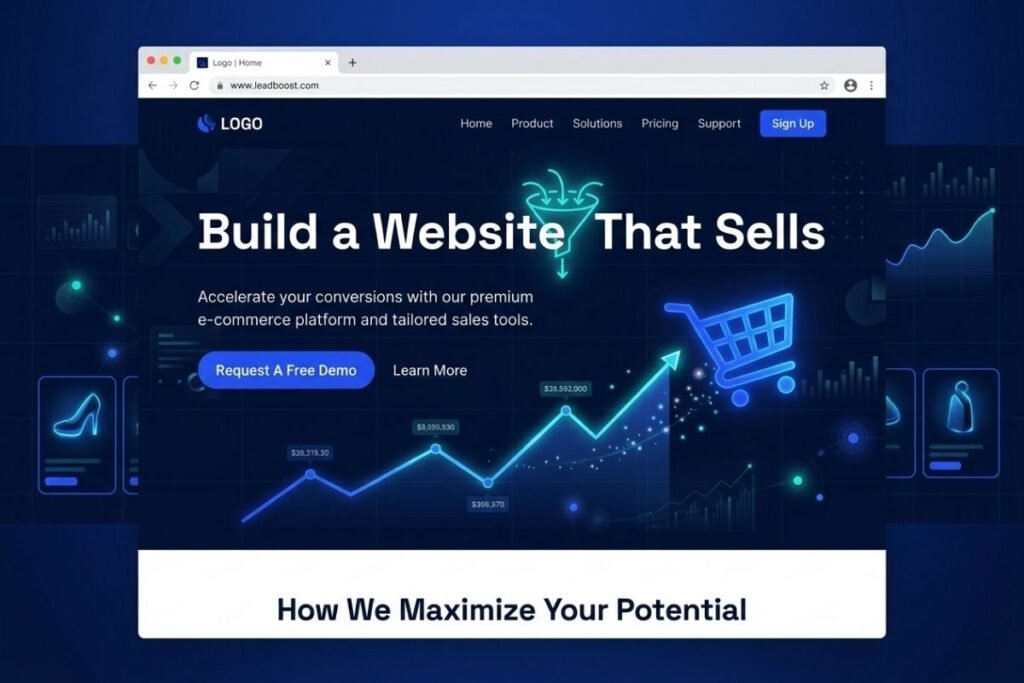
The Ultimate Guide to Building a Website That Sells
You’ve invested in a professional-looking website. The traffic is coming. But the sales? They’re not matching your expectations. You’re not alone. Countless business owners pour resources into driving visitors to a site that simply isn’t built to convert. The gap between a beautiful website and a revenue-generating website is wider than most realize – and bridging it requires understanding the psychology of online buying behavior, the mechanics of conversion-focused design, and the infrastructure that transforms casual browsers into loyal customers. A website that sells is a carefully orchestrated system where every element – design, copy, user flow, trust signals, speed, and follow-up – works together to guide visitors toward a confident buying decision. When these elements align, your website becomes your hardest-working salesperson, operating 24/7 to generate leads and close deals without additional effort from you.
At Webtoz, we’ve spent years analyzing what makes websites convert – studying user behavior, testing design elements, and optimizing sales funnels across industries. What we’ve discovered is that high-converting websites share a common DNA. They don’t rely on guesswork or trends. They’re built on proven principles of conversion science, user psychology, and strategic content. As we outlined in our guide on why a professional website is the cornerstone of modern business success, your website is foundational. But professionalism alone isn’t enough – it must be purpose-built to convert. Explore our services and pricing to see how we implement these strategies for businesses like yours.
In this comprehensive guide, you’ll discover the complete framework for building a website that generates consistent sales – from foundational strategy and conversion-focused design to persuasive copywriting, technical optimization, and post-launch growth tactics. You’ll learn the exact elements that turn passive pages into active revenue generators, the most common conversion killers that silently cost you sales, and a step-by-step process for building (or rebuilding) a website engineered for revenue. For a deeper look at how modern design impacts your bottom line, read our companion piece on how modern website design can double your leads.
📖 In This Guide
- Understanding the Psychology of Online Buyers
- The Conversion Foundation: Strategy Before Design
- Conversion-Focused Design Elements That Drive Sales
- Persuasive Copywriting: Words That Sell
- Building Trust and Credibility That Converts
- User Experience: Removing Friction From the Buying Journey
- Technical Optimization: Speed, Mobile, and SEO
- The 10 Most Common Conversion Killers
- Post-Launch: Testing, Analytics, and Continuous Improvement
- The Complete Website-That-Sells Framework
1. Understanding the Psychology of Online Buyers
Before a single pixel is placed or a line of copy written, you must understand what drives people to buy online. A website that sells doesn’t just present products – it aligns with the psychological triggers, emotional needs, and decision-making patterns of your target audience. Without this foundational understanding, even the most visually stunning website will underperform. As we explored in the Webtoz blueprint for digital dominance, strategy precedes execution every time.
The Emotional Decision Engine
Neuroscience confirms that purchasing decisions are primarily emotional, then justified with logic. Your website must speak to both. Emotional triggers – desire, fear of missing out, belonging, status, relief from pain – drive the initial impulse. Logical elements – features, specifications, comparisons, guarantees – provide the rational justification needed to complete the purchase. A website that sells masterfully balances both, creating emotional resonance in headlines, imagery, and storytelling, then sealing the deal with logical proof points.
The 8-Second Attention Window
Research shows the average online attention span is approximately 8 seconds. Your website has a single-digit window to capture interest before a visitor bounces. This means your value proposition must be instantly clear. Your headline must hook. Your design must guide the eye to what matters most. Learn more in our guide on web design mistakes killing conversions.
The Trust-Verification Loop
Online buyers operate in a constant state of micro-skepticism. Every claim you make is subconsciously questioned. Every promise is evaluated against visible proof. High-converting websites anticipate and satisfy this skepticism proactively – through testimonials, case studies, trust badges, transparent pricing, clear guarantees, and social proof. Every time a doubt arises in the visitor’s mind, your website should have already answered it on the page.
The integrated view: A website that sells understands that buyers move through emotional engagement (the spark), logical justification (the fuel), and trust verification (the engine). When all three are present and aligned, conversion happens naturally. When any one is missing, the buying process stalls. Read our piece on how a strong online presence transforms small businesses to see these principles in action.
2. The Conversion Foundation: Strategy Before Design
The most common mistake businesses make is jumping straight into design without first establishing a conversion strategy. A website that sells is built on a clear strategic foundation – one that defines exactly who you’re selling to, what action you want them to take, and how you’ll guide them from arrival to conversion. Our digital creation services always begin with this strategic groundwork.
🎯 Define Your Primary Conversion Goal
Every website that sells has one clearly defined primary conversion goal. This could be a product purchase, a consultation booking, a quote request, a subscription signup, or a phone call. The key is singularity – when a website tries to convert visitors toward too many competing actions, conversion rates fragment and drop. Identify the single most valuable action a visitor can take, and build your entire site architecture to support that goal. Secondary conversions (newsletter signups, social follows, content downloads) should support – not compete with – the primary goal. Need help defining yours? Our services and pricing page outlines how we help businesses clarify their conversion objectives.
👤 Build Detailed Buyer Personas
You cannot sell effectively to someone you don’t understand. Detailed buyer personas go beyond basic demographics – they capture psychographics, pain points, buying objections, information needs, preferred channels, and the emotional drivers behind purchasing decisions. A website built for a specific persona will always outperform one built for “everyone.” Create 2-3 primary personas, give them names, and design every page as if you’re speaking directly to that person. When visitors feel seen and understood, conversion rates increase dramatically. Our guide on how a cohesive brand identity builds a business explores persona-aligned branding in depth.
🗺️ Map the Customer Journey
A conversion-focused website is a guided journey, not a random collection of pages. Map out exactly how different visitor types will enter your site (organic search, ads, social media, direct), what information they’ll need at each stage of awareness, and what logical next step moves them closer to conversion. Each page should have a clear purpose in the journey and a clear path to the next step. Dead-end pages – those with no clear call-to-action or next step – are conversion killers. Every page should answer “What do I want the visitor to do next?” and make that action obvious and easy.
📊 Establish Key Performance Indicators (KPIs)
You can’t improve what you don’t measure. Before launching, define the metrics that matter: conversion rate, average order value, cart abandonment rate, time to purchase, cost per acquisition, customer lifetime value. Set baseline targets and establish the analytics infrastructure to track them. Websites that sell are data-informed – they use real visitor behavior to continuously refine and improve. For guidance on measurement frameworks, explore how data-driven paid advertising scales businesses.
3. Conversion-Focused Design Elements That Drive Sales
Once your strategic foundation is set, design becomes the vehicle that delivers the conversion experience. Conversion-focused design is not about aesthetics alone – it’s about visual hierarchy, attention direction, and cognitive ease. Every design element should serve a purpose. If it doesn’t help move visitors toward conversion, it’s taking up valuable space. As detailed in our article on modern website design doubling your leads, design directly impacts revenue.
Strategic Visual Hierarchy
Visitors don’t read – they scan. Your design must guide the eye to the most important elements in the right order. Use size, color, contrast, whitespace, and positioning to create a clear visual path. Our guide on design mistakes covers hierarchy errors in detail.
High-Contrast CTAs
Your CTA buttons must be impossible to miss and irresistible to click. Use contrasting colors, action-oriented copy, and position them at natural decision points throughout the page.
Benefit-Driven Visuals
Images and videos on a website that sells do more than decorate – they demonstrate value and build desire. Use product photos in context, explainer videos, and real customer imagery.
Strategic Whitespace
Cluttered pages overwhelm visitors. Generous whitespace improves comprehension, reduces cognitive load, and directs attention toward what matters most.
4. Persuasive Copywriting: Words That Sell
Design gets attention. Copy closes the sale. The words on your website carry enormous weight – they must resonate emotionally, communicate value clearly, overcome objections preemptively, and guide the reader toward confident action. Our guide on strategic content creation explores these principles across channels.
5. Building Trust and Credibility That Converts
Trust is the invisible currency of online sales. Visitors won’t buy from a website they don’t trust – no matter how good the offer. Building trust isn’t about a single element; it’s about consistent credibility signals woven throughout the entire website experience. As outlined in our article on how local businesses can build a powerful online identity, trust begins with authentic presence.
Authentic Social Proof
Display real testimonials, case studies, reviews, and client logos prominently. Video testimonials are particularly powerful. Include specific results when possible. Third-party review platform badges add external validation.
Risk Reversal & Guarantees
A strong guarantee removes the fear of making a wrong decision. Money-back guarantees, free trials, satisfaction assurances – these signals tell visitors you stand behind your offering. Our services and pricing page demonstrates transparent business practices.
Security & Professional Signals
SSL certificates, secure payment badges, visible privacy policies, professional design, up-to-date copyright dates – these elements signal legitimacy. Every detail either adds to or subtracts from your trustworthiness.
6. User Experience: Removing Friction From the Buying Journey
Friction is the enemy of conversion. Every unnecessary click, confusing navigation element, slow-loading page, or complicated form field reduces the likelihood of a sale. User experience optimization is the systematic process of identifying and eliminating these friction points. For practical examples, see our guide on affordable ways small businesses can stand out online.
🖱️ Simplify Navigation and Site Architecture
Visitors should reach any important page within 2-3 clicks from anywhere on your site. Limit main navigation to 5-7 items. Use clear, descriptive labels. Include a search function for larger sites. Ensure navigation works flawlessly on mobile devices. A confused visitor doesn’t convert – clear navigation keeps them moving confidently toward the sale.
📱 Mobile-First Design Is Non-Negotiable
With mobile traffic often exceeding 60% of website visits, your mobile experience is your primary experience. Mobile-first design means designing for smaller screens first, then scaling up. Every element must be touch-friendly, text must be readable without zooming, and forms must be simplified for mobile input. Mobile conversion rates directly impact your revenue.
🛒 Streamline Checkout and Forms
Every additional form field reduces conversion rates. Only ask for information you absolutely need. Use inline validation to catch errors in real-time. Offer guest checkout – don’t force account creation. Show progress indicators for multi-step processes. The easier you make it to complete the purchase, the more purchases you’ll complete.
🔍 Clear Product and Service Presentation
Confusion kills sales. Each product or service page should provide complete information: clear descriptions, pricing, specifications, high-quality images, availability, delivery timelines, and a prominent add-to-cart or inquiry button. Anticipate and answer every question a buyer might have before they need to ask.
7. Technical Optimization: Speed, Mobile, and SEO
A conversion-optimized design and persuasive copy mean nothing if your website loads slowly, breaks on mobile, or can’t be found in search results. Technical optimization is the invisible infrastructure that supports your conversion engine. As we covered in how proper Google setup fuels continuous business growth, technical foundations directly impact revenue.
⚡ Page Speed Optimization
A 1-second delay in page load time can reduce conversions by 7%. Google’s Core Web Vitals now directly impact search rankings. Optimize images, leverage browser caching, minimize HTTP requests, use a CDN, and choose performance-optimized hosting.
📱 Responsive and Mobile-Optimized
Google uses mobile-first indexing – the mobile version of your site is the primary version for search ranking. Your website must deliver a flawless experience across all devices and screen sizes.
🔍 SEO for Sustainable Traffic
A website that sells needs consistent, qualified traffic. Search engine optimization provides sustainable, cost-effective visitor flow. Optimize title tags, create intent-aligned content, build quality backlinks, and implement schema markup.
8. The 10 Most Common Conversion Killers
Sometimes the fastest way to improve conversions is to eliminate what’s working against you. After analyzing hundreds of websites, we’ve identified the most common elements that silently sabotage sales. Check your website against this list – each item you fix moves you closer to a website that sells. For an expanded discussion, see our dedicated guide on 10 web design mistakes killing conversions.
- 1. Unclear Value Proposition: Visitors can’t immediately tell what you offer, who it’s for, and why they should choose you.
- 2. Weak or Missing Calls-to-Action: Pages without clear next steps leave visitors with nowhere to go.
- 3. Slow Page Load Times: If your site takes more than 3 seconds to load, you’re losing a significant percentage of potential customers.
- 4. Poor Mobile Experience: Pinching, zooming, misaligned elements, and tiny buttons frustrate mobile users and drive them to competitors.
- 5. Lack of Trust Signals: No testimonials, no reviews, no guarantees, hidden contact information – all suppress conversion.
- 6. Complicated Checkout or Contact Processes: Too many form fields, forced account creation, unclear pricing cause abandonment.
- 7. Generic Stock Photography: Inauthentic imagery signals “template” rather than “real business.” Custom photography builds connection and trust.
- 8. Auto-Playing Media: Unexpected audio or video that plays automatically is disruptive – especially on mobile where data usage matters.
- 9. Outdated Design or Content: Old copyright dates, broken links, and dated design aesthetics signal neglect and erode credibility instantly.
- 10. No Clear Differentiation: When your website looks and sounds like every competitor, price becomes the only differentiator.
9. Post-Launch: Testing, Analytics, and Continuous Improvement
Launching your website is not the finish line – it’s the starting point of an ongoing optimization process. Websites that sell sustainably are never “finished.” They evolve based on data, testing, and changing customer behavior. As explored in how data-driven paid advertising scales businesses, continuous improvement based on performance data is the key to long-term success.
Install Analytics Properly
Google Analytics, heat mapping tools, and conversion tracking must be properly configured before launch. Without this data, optimization is guesswork.
A/B Testing: Let Data Decide
Never assume you know what works best. A/B testing compares two versions to see which converts better. Small improvements compound – a series of 5% conversion increases can double your revenue over time.
Regular Updates & Maintenance
A stagnant website loses ranking, relevance, and trust. Regularly update content, refresh product information, add new testimonials, and maintain technical health.
How to Build a Website That Sells
Use this practical framework to turn the strategy in this guide into a conversion-focused website plan.
Define the Primary Conversion Goal
Choose the single most valuable action your website should drive, such as a consultation request, product purchase, quote request, or signup.
Map the Buyer Journey
Identify how visitors arrive, what questions they need answered, and which page elements move them toward the next decision.
Design for Clarity and Trust
Use clear headlines, focused calls to action, strong visual hierarchy, proof points, testimonials, guarantees, and transparent contact information.
Write Conversion-Focused Copy
Lead with the visitor’s problem, explain the outcome they want, support every claim with evidence, and make the next action obvious.
Optimize Speed and Mobile UX
Compress images, simplify scripts, test forms on mobile, and remove friction from every important conversion path.
Measure, Test, and Improve
Track conversion rate, form completion, page speed, and visitor behavior, then use those insights to improve headlines, layouts, offers, and calls to action.
10. Final Thoughts: Your Website as Your Best Salesperson
Building a website that sells is not about a single magic element – it’s about the thoughtful integration of strategy, psychology, design, copy, trust, user experience, and technical excellence. When these elements work together, your website becomes more than an online brochure. It becomes a 24/7 sales engine – generating leads, nurturing prospects, closing deals, and building customer relationships while you sleep. As we explored in why your online presence defines your business success, your website is the hub of your entire digital identity.
The businesses that win online are not necessarily the ones with the biggest budgets or the most traffic. They’re the ones that understand conversion deeply and execute consistently. They test, they optimize, they listen to their customers, and they continuously refine the online buying experience. The good news is that every business can adopt this approach. Whether you’re launching a new website or optimizing an existing one, the principles in this guide provide a complete framework for building a website that doesn’t just look good – it sells.
Ready to transform your website into a revenue-generating asset? Explore our services and pricing to see how Webtoz implements these strategies for businesses across industries. Read our digital creation services overview for a complete picture of how we build websites that sell. For answers to common questions, visit our FAQ page. And if you’re ready to start the conversation, contact us today. Your website can be your hardest-working salesperson – it just needs the right foundation, strategy, and execution.
The difference between a website that simply exists and a website that consistently generates revenue isn’t luck – it’s intentional design. Every element covered in this guide contributes to the outcome. Start with your strategy. Build with conversion in mind. Test relentlessly. Improve continuously. Your next customer is searching for exactly what you offer. Make sure your website is ready to sell when they arrive.
About Webtoz Solutions Team
Webtoz is a full-service web development, software development, and technology consultancy specializing in custom digital products that drive measurable business results. Our team combines senior engineering talent with strategic consultancy thinking to build websites and software that don’t just look great – they generate leads, convert visitors, and grow businesses. Learn more about our team, explore our services, or get in touch to discuss your project.
Ready to Transform Your Website Into a Revenue Engine?
Let’s discuss your project. From strategy through launch and optimization, Webtoz builds websites engineered for conversion. Explore our services or reach out directly to start the conversation.
Explore Our Services →