Progressive Web Apps (PWA): What They Are and Why Businesses Are Building Them
Native mobile apps are expensive to build, expensive to maintain across two platforms, and depend entirely on users downloading them from an app store. A Progressive Web App (PWA) closes much of that gap — delivering an installable, offline-capable, app-like experience directly through the browser.
This guide explains what a PWA actually is, the real business cases where it outperforms both a plain website and a native app, and how it fits into a broader custom web development strategy.
You will learn the core technical features that define a PWA, real business use cases, and how to know if it is the right investment for your product.
📖 In This Guide
1. What Is a Progressive Web App?
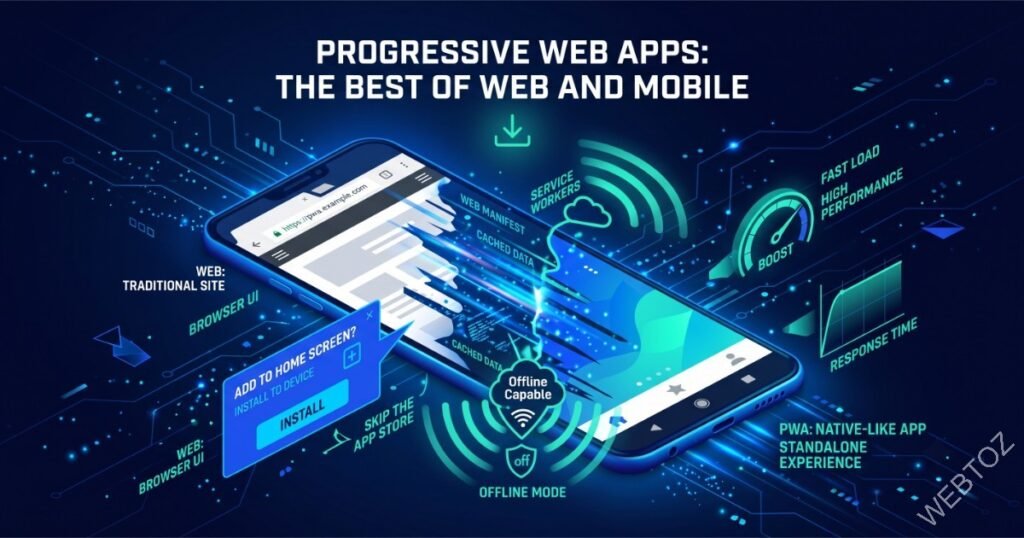
A PWA is a website built using modern web capabilities so that it can behave like a native app: it can be installed to a home screen, work offline or on poor connections, send push notifications, and load instantly on repeat visits. Crucially, it is still just a website — one URL, one codebase, indexed by search engines like any other page.
Installable
Adds to the home screen directly from the browser, no app store required.
Works Offline
Service workers cache key assets so the app remains usable without a connection.
Push Notifications
Re-engage users directly, similar to a native app.
2. Core Features That Define a PWA
Three technical building blocks make a PWA possible: a web app manifest that describes how the app should appear when installed, a service worker that manages caching and offline behaviour, and HTTPS, which is required for both. None of these require abandoning your existing web stack — they layer on top of it.
3. PWA vs Native App: A Practical Comparison
4. Real Business Use Cases for PWAs
- E-commerce: Faster repeat purchases without requiring an app store download; see our guide on e-commerce website development.
- Field service tools: Offline access for technicians working in low-connectivity areas.
- News and content platforms: Instant loading and push notifications drive repeat engagement.
- Internal business tools: Faster rollout than native, with a single build to maintain.
5. Common Questions
5. Common Questions
Can a PWA replace a native app entirely?
For many businesses, yes — but not for apps that depend heavily on deep device integration. If your product needs advanced camera controls, Bluetooth, or complex background processing, native may still be necessary alongside or instead of a PWA.
Is a PWA good for SEO?
Yes, since a PWA is still fundamentally a website with a normal URL. Unlike a native app, its pages are fully crawlable and indexable, and the performance gains typically improve Core Web Vitals scores.
How to Approach Building a PWA
1. Audit Your Current Site
Assess how close your existing site already is to PWA-ready.
2. Define Offline Requirements
Decide which content or features must work without a connection.
3. Implement the Manifest & Service Worker
Add the core technical building blocks that enable install and offline behaviour.
4. Test Across Devices
Validate install behaviour and offline caching on both iOS and Android.
5. Add Push Notifications
Layer in re-engagement features once the core PWA is stable.
6. Monitor Install & Engagement Rates
Track how many users install the app and how it affects retention.
6. Final Thoughts: The Web Is Catching Up to Apps
PWAs will not replace every native app, but for a large share of businesses they close the gap at a fraction of the cost. If your priority is reach, speed, and lower maintenance overhead, a PWA deserves serious consideration before defaulting to native.
Curious whether a PWA fits your product? Contact us to discuss your requirements, or explore our software development services.
About Webtoz Solutions Team
Webtoz is a full-service web development, software development, and technology consultancy. Learn more about our team, explore our services, or get in touch.
Ready to Give Your Users an App-Like Experience?
Let us assess whether a PWA is the right fit for your product and your budget.
Get in Touch →