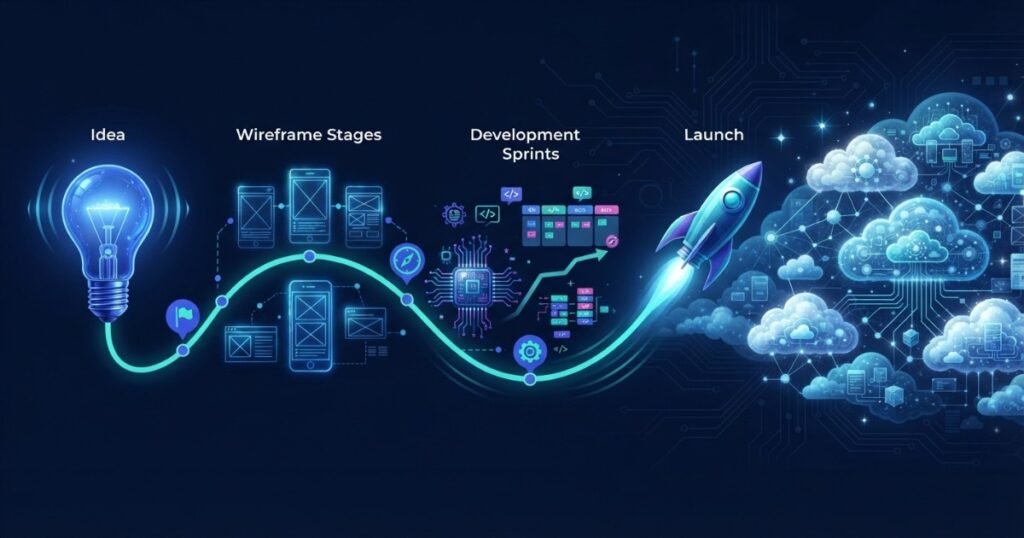
SaaS Product Development: From Idea to Launch — Step-by-Step Guide
Building a SaaS product looks deceptively similar to building any other web application right up until you hit the specific technical requirements that make software-as-a-service its own genuinely distinct category. SaaS development means architecting for multiple paying customers sharing (or safely isolated from) the same underlying system, building recurring billing and subscription management directly into the product, designing onboarding that gets a new user to value without a sales call, and treating security and compliance as core product requirements rather than afterthoughts. Get these fundamentals right early, and the product scales smoothly. Get them wrong, and you’re rebuilding core architecture while paying customers are already relying on it.
At Webtoz, SaaS builds draw on the same disciplined process we bring to any custom software development project, with the added architectural considerations specific to multi-tenant, subscription-based products — a natural extension of the guidance in custom web application development timelines and costs.
This guide walks through validating the idea before writing code, choosing the right technical architecture, handling billing and multi-tenancy correctly, building in security and compliance from the start, and the common mistakes that derail SaaS products before they ever find their footing.
📖 In This Guide
- What Makes SaaS Development Different
- Validating the Idea Before Writing Code
- Choosing the Right Technical Architecture
- SaaS Architecture Decisions
- Billing, Subscriptions, and Multi-Tenancy
- Security and Compliance for SaaS
- Common SaaS Development Mistakes
- How to Take a SaaS Product from Idea to Launch
- Final Thoughts: Architecture Is the Foundation
1. What Makes SaaS Development Different
A standard business website serves largely the same content to every visitor. A SaaS product does something genuinely different for every single customer — different data, different permissions, different subscription tiers unlocking different features — all running on shared underlying infrastructure. This introduces architectural requirements that simply don’t exist in a typical website: strict data isolation between customers, subscription state that gates access to features in real time, and an onboarding flow that has to work without a human explaining anything, since most SaaS customers self-serve rather than talking to a salesperson first.
It’s worth internalising early that a SaaS product is never really “finished” the way a marketing website might be. It’s a living system that needs to keep evolving in response to customer feedback, competitive pressure, and the accumulating weight of edge cases that only show up once real paying customers start using it in ways you never anticipated during planning.
This also changes how success gets measured. A marketing website’s success is largely about traffic and conversion at a single moment. A SaaS product’s success plays out continuously, month after month, through retention, expansion revenue, and how often existing customers renew rather than churn — metrics that only reveal themselves well after launch, which is exactly why the architecture needs to support ongoing iteration rather than a one-time ship.
2. Validating the Idea Before Writing Code
The single most expensive mistake in SaaS development isn’t a technical one — it’s building a fully-featured product before confirming anyone actually wants to pay for it. Talking to potential customers, testing willingness to pay with a landing page and a waitlist, or building a manual, unscalable version of the service to prove demand before investing in a scalable engineered version all reduce the risk of spending months building something the market doesn’t actually want. Validation isn’t a box to check quickly on the way to building — it’s an ongoing discipline that should continue well past launch.
A useful discipline here is treating every early assumption as explicitly unproven until real customer behaviour confirms it. It’s easy to mistake polite interest — “that sounds interesting” — for genuine validated demand, and the gap between the two is exactly where many SaaS founders spend months building a product that generates enthusiasm in conversation but never converts to actual paying customers.
Should I build an MVP before investing in full SaaS infrastructure?
In almost every case, yes — validating demand with a leaner version before investing in the full multi-tenant, billing-integrated infrastructure protects you from building expensive architecture around an unproven idea. The key is being deliberate about which shortcuts are safe to take temporarily and which core architectural decisions genuinely need to be right from the very first version, since some early shortcuts are far more expensive to unwind later than others.
3. Choosing the Right Technical Architecture
The core architectural decision in any SaaS product is how customer data gets isolated from one another. A shared database with strict tenant-level filtering is simpler to build and operate at small scale, while a fully separated database-per-customer model offers stronger isolation and easier compliance at the cost of significantly more operational complexity as the customer count grows. Many SaaS products start with the simpler shared model and migrate toward more isolation only once scale or compliance genuinely demands it — building maximum isolation on day one for a product with ten customers is usually solving a problem you don’t have yet, at the expense of the speed you actually need in those critical early months.
4. SaaS Architecture Decisions
The “simple” column isn’t a compromise or a lesser choice — it’s the right default for the overwhelming majority of SaaS products, especially in the early stages. Reaching for the advanced approach prematurely tends to slow down development without delivering proportional benefit until the business has actually grown into needing it.
5. Billing, Subscriptions, and Multi-Tenancy
Recurring billing sounds simple until you account for upgrades, downgrades, proration, failed payments, trial periods, and cancellations — each of which has genuine edge cases that need explicit handling. Using an established billing platform rather than building subscription logic from scratch is almost always the right call, since these platforms have already solved the countless edge cases that a custom-built billing system would need to rediscover the hard way, often through unhappy customers. Multi-tenancy adds its own layer of complexity on top — every feature you build needs to be considered through the lens of “how does this behave correctly across many different customers using the system simultaneously.”
Failed payment handling in particular deserves more attention than it usually gets in initial planning. A card that expires or a payment that fails shouldn’t immediately cut off a customer’s access — a graceful retry and grace-period sequence, with clear communication along the way, preserves far more revenue than an abrupt cutoff that turns a temporary billing hiccup into an avoidable cancellation.
6. Security and Compliance for SaaS
SaaS products carry a distinct security burden compared to a typical website, since customers are trusting you with their actual business data, often on an ongoing basis rather than a single transaction. This means encrypting data at rest and in transit, implementing role-based access control so users only see what they’re supposed to, maintaining detailed audit logs for security-conscious customers who ask for them, and building toward whatever compliance certifications your target market actually expects before those requirements become a blocker to closing enterprise deals. Retrofitting security architecture after a product already has paying customers is significantly harder and riskier than building it in from the start.
It’s also worth planning ahead for the compliance conversation, even before it’s strictly necessary. Enterprise customers routinely ask detailed security questions during their own procurement process, and having clear, documented answers ready — rather than scrambling to produce them under deal pressure — can be the difference between closing a significant account and losing it to a competitor who was simply better prepared.
7. Common SaaS Development Mistakes
These mistakes recur across countless SaaS launches, often because founders are moving fast and haven’t hit the specific pain each one causes yet — right up until they do, usually at the worst possible moment.
- Building every feature before launching: Delaying real customer feedback while polishing features nobody has asked for yet.
- Custom-building billing logic from scratch: Rediscovering every edge case an established platform has already solved.
- Weak tenant data isolation: A single bug that leaks one customer’s data to another can be catastrophic for trust.
- No onboarding flow testing: Assuming a new user will figure it out without ever watching a real person try.
- Ignoring compliance until an enterprise deal demands it: Scrambling to retrofit certifications under deadline pressure.
- Underinvesting in monitoring: Not knowing a critical feature is broken until customers start cancelling.
- No clear pricing strategy before launch: Pricing is far harder to change after customers are already anchored to a number than to get reasonably right from the start.
How to Take a SaaS Product from Idea to Launch
A practical sequence for moving from concept to a live, paying customer base.
1. Validate Demand
Confirm real willingness to pay before investing in full infrastructure.
2. Design Core Architecture
Choose your tenancy, billing, and infrastructure approach deliberately.
3. Build a Focused MVP
Ship the smallest version that delivers genuine value to real users.
4. Integrate Billing Early
Get subscription and payment flows working before public launch, not after.
5. Test Onboarding Relentlessly
Watch real people try to sign up and reach value without help.
6. Launch and Monitor Closely
Watch usage and errors closely in the critical early weeks after launch.
8. Final Thoughts: Architecture Is the Foundation
A SaaS product’s long-term trajectory is set far more by its early architectural decisions than by any single feature it ships. Getting tenant isolation, billing, and security right from the start means every feature built afterward stands on solid ground, rather than requiring a painful, customer-facing migration to fix a foundational gap discovered too late. Validate the idea first, architect deliberately, and let real usage — not assumptions — guide what gets built next, one release at a time.
Building a SaaS product and want the architecture right from day one? Explore our custom software development services, review our pricing, or contact us to discuss your idea and how it could come together.
About Webtoz Solutions Team
Webtoz is a full-service web development, software engineering, and technology consultancy, helping founders architect and launch SaaS products the right way. Learn more about us, or get in touch to discuss your idea.
Ready to Build Your SaaS Product?
Let Webtoz architect and build your SaaS product with billing, security, and multi-tenancy handled correctly from day one.
Get in Touch →